

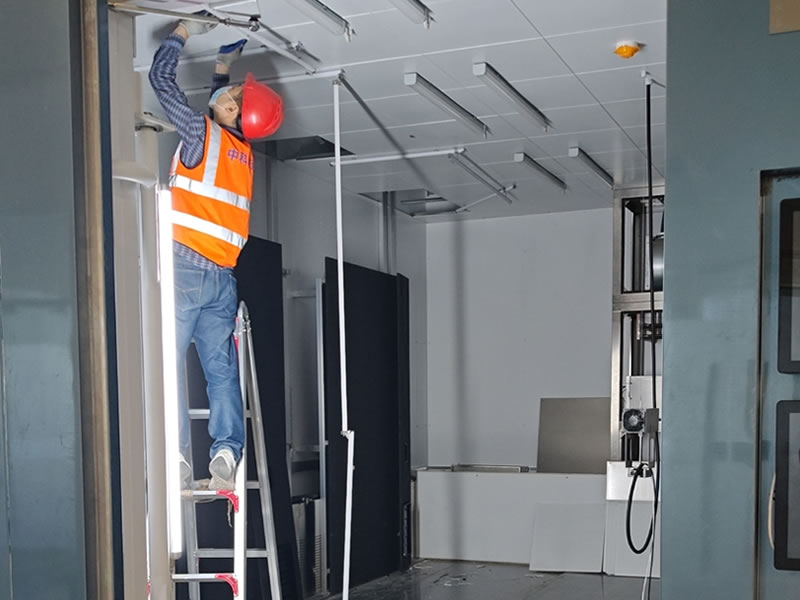
The refrigerator performance testing laboratory is a method for testing various performance indicators of refrigerators and serves as an effective and reliable means of assessing product quality. According to national standards for refrigerator performance testing, the laboratory tests include power consumption testing, storage temperature testing, freezing capacity testing, cooling speed testing, temperature recovery testing, and defrosting testing, among others. All tests and experiments are required to be conducted under specific temperature and humidity conditions, known as working conditions. The adjustment of these working conditions usually requires automatic implementation, meaning that after manually setting the desired working condition values, the testing system automatically regulates the environmental conditions to approach the specified values and automatically determines whether stable working conditions have been achieved.
Under these working conditions, the system must be able to measure parameters such as the internal temperature of the refrigerator, the temperature of the temperature sensor, the evaporator temperature, power, and power consumption, through computer control of external devices and measuring instruments. It should also display real-time data and change curves for environmental temperature, freezing temperature, refrigeration temperature, frozen load temperature, compressor temperature, voltage, current, power, and power consumption. Additionally, the system should have the functionality to store, print, and query test data and parameter curves. Furthermore, the system is required to automatically or manually control the on/off operation of the refrigerator compressor through software and to provide audible and visual alarms for faults such as compressor overload, high/low pressure, overheating, and lack of water in the humidifier, with the computer displaying the fault category and location.
1.Key Technologies and Implementation
While the system is running, it must frequently communicate with instruments and process a large amount of data. If data must be read from the server database every time a curve is drawn, it will increase data transmission on the network, consume a significant amount of system resources, and reduce software efficiency. To solve this problem, we use an in-memory buffering method. The specific implementation method is to define a class in the program, setting its member variables to correspond one-to-one with the fields in the database. During system operation, each time data is collected, it should be written to the database and simultaneously to the variables. When refreshing the screen to redraw the curve, the required data can be read directly from the variables instead of from the database, thus avoiding database read operations, conserving system resources, and speeding up system operation. Since the sampling time is not fixed, it is neither necessary nor possible to allocate a fixed storage space for all test data during program initialization. Considering the overall performance of the system, we also cannot use dynamic allocation functions to dynamically allocate space for each collected data point. In this case, we adopt a compromise method by initially defining a block of storage space in increments of 5000B. If data overflow is detected during testing, this space will be incrementally defined based on the 5000B unit. This approach balances both aspects and achieves relatively good results in practical applications.
2.Curve Display and Querying
If each time a curve for a station is displayed, data is read from the server database and redrawn, it not only increases the network load on the system but also results in unacceptable drawing speeds for customers. To address this issue, each testing station’s curve should be drawn on its corresponding picture control. This improves online query speed and conserves system network resources.
Since the duration of the system is variable, it must allow users to set the display range of the time axis coordinates. The default maximum scale of the time axis is max. After the user sets the time range, the theoretical scale interval is calculated using a formula. A value is then set to assign initial values to the first N components, and other component values are calculated using the formula. After this processing, the resulting curves are both intuitive and clear.
Additionally, one important indicator of refrigerator requirements is low noise. The compressor is a major power source for the refrigerator and also a primary source of vibration and noise. The dynamics of structures such as silencers, springs, and refrigerant pipelines remain a current research hotspot.
As Kim et al. designed a new intake silencer using numerical methods, the overall performance of the compressor was improved. Chang et al. used genetic algorithms (GA) to evaluate the parameters of the silencer and completed its design. Wang Fumao et al. established a vibration isolation system model for the refrigerator compressor and studied the effects of parameters such as spring stiffness and support spacing on the force transmission rate. Han et al. reduced the vibration radiation noise of the refrigerator pipeline by changing the shape and layout of the evaporator inlet pipe.
The noise sources of refrigerator compressors are complex, and identifying and analyzing the main noise sources is particularly important in noise control engineering. This paper addresses issues such as excessive overall noise and low-frequency vibration during the operation of a specific model compressor under standard conditions. Experimental testing and noise analysis were conducted on the prototype, and improvement proposals were made based on the analysis results, which were then verified.
3.Compressor Noise Signal Acquisition System
3.1Introduction to the Compressor
This model of compressor is a single-cylinder piston compressor, with a rated power of 600 W, a rated current of 3 A, and a rated speed of 2,950 r/min. It is applicable for LBP/MBP with a cooling capacity of 820 W, suitable for commercial refrigerators and large supermarket freezers.
3.2 Noise Signal Acquisition System
The noise testing environment is a semi-anechoic chamber, complying with the “GB/9098-2008 Electric Motor-Compressors for Refrigerators” testing standards. The compressor is equipped with vibration-damping pads, and the anchor bolts are not fixed; the compressor’s suction/discharge pipes are connected to an external refrigeration system using a non-rigid connection. The A-weighted sound power level measurement method is used, with a hemispherical measurement surface radius of r (r >= 1.0 m) and a layout of 10 measurement points. The testing utilized Danish GRAS-46AE acoustic sensors, the HEAD Recorder 4.0 data acquisition system, and Artemis Suite 6.0 data analysis software for data processing.
The average A sound level dB(A) of the 10 measurement points in the semi-anechoic chamber is given by:
LˉpA = 10 lg [ 1/10 ∑(i = 1 to 10) 100.1 ( LpAi – K1i ) ]
Where LpAi is the A sound level measured at the i-th measurement point in dB(A), and K1i is the background noise correction value at the i-th measurement point.
4.Compressor Noise Testing and Spectrum Analysis
4.1 Noise Testing with Component Removal
To identify the main noise sources radiated by the compressor during steady-state operation, five different testing conditions were designed based on reproducibility principles:
(1) Standard condition, with refrigerant R404a;
(2) No-load condition (without refrigerant) with pneumatic components removed (suction/discharge valve plates, cylinder head, silencer cover, intake silencer, discharge pipe);
(3) No-load condition with both pneumatic and moving components (piston, piston pin, connecting rod, elastic positioning pin) removed;
(4) Standard condition with the intake silencer removed;
(5) Testing condition as close to standard as possible with the discharge pipe removed.
The disassembled core of the compressor was placed in a new shell, resealed by welding, and filled with the same amount of oil as in the standard condition. It was then placed in the semi-anechoic chamber, and the refrigeration system piping was connected for sound pressure testing and sound power level calculation, with the results of the 10 measurement points shown in Table 2.
When the pneumatic components were removed and the compressor operated in no-load conditions, the noise was primarily mechanical and electromagnetic noise from the compressor. Under standard operating conditions, in addition to mechanical and electromagnetic noise, there was also noise from refrigerant gas flow pulsations. Comparing the overall noise test data, the sound power levels of the two differed by 18.45 dB, indicating that gas flow pulsations significantly affect the overall noise of the compressor. When operating without pneumatic and moving components, the main noise source of the compressor was electromagnetic noise, with a measured noise level of 29.47 dB, which was close to the background noise of the semi-anechoic chamber. Compared to the compressor with only pneumatic components removed, the difference in mechanical noise was 38.19–29.47=8.72 dB, indicating that the main noise source of this model compressor is aerodynamic noise, followed by mechanical noise, while electromagnetic noise has a smaller impact on the overall noise.
Intake and exhaust noise are also major noise sources of piston compressors, and the design of intake silencers and exhaust pipes significantly affects the suppression of intake and exhaust noise. After removing the intake silencer from the compressor, the sound power level increased by 5.42 dB compared to standard conditions. The noise level when the discharge pipe was removed differed from that under standard conditions by 4.18 dB, indicating that intake noise is stronger than exhaust noise.
4.2 Noise Spectrum Analysis After Component Removal
To further clarify the distribution of compressor noise sources and the frequency bands for noise reduction, noise data from five different operating conditions were analyzed using Artemis Suite 6.0 software. From the comparison of the noise source spectra between standard conditions and the condition with pneumatic components removed, it was found that the compressor’s aerodynamic noise primarily distributes in the frequency bands of 200 Hz to 800 Hz and 1,500 Hz to 16,000 Hz, showing a wide frequency distribution characteristic. Particularly around 2,000 Hz, the maximum difference in aerodynamic noise was 33 dB, which is the main frequency band for noise reduction control of the compressor. The spectrum of noise sources when both pneumatic and moving components were removed showed that the peak of electromagnetic noise was 20 dB at a frequency of 1,600 Hz, indicating that electromagnetic noise has a minor effect on the overall noise of the compressor. Comparing the noise source spectra of the condition with only pneumatic components removed to that of the condition with both pneumatic and moving components removed, it was found that the mechanical noise of the compressor primarily distributes between 100 Hz and 200 Hz and 500 Hz to 4,000 Hz, caused by vibration noise from unbalanced forces in the rotor system and friction noise from the interactions of the crankshaft, piston, and connecting rod, with minimal impact above 4,000 Hz.
Therefore, the intake silencer mainly reduces mid- to low-frequency noise and has a limited effect on suppressing high-frequency aerodynamic noise around 2,000 Hz. Comparing the noise source spectra under standard conditions, the noise level of the compressor at 50 Hz, 100 Hz, 150 Hz, and 200 Hz decreased after removing the discharge pipe. The theoretical analysis shows that the vibration noise excitation source of the discharge pipe is the compressor, with the excitation frequency given by f=n∙z∙i/60, where n is the speed, z is the cylinder parameter (1 for a single cylinder), and i is the harmonic frequency order. The calculated harmonic noise frequencies are 49.2 Hz, 98.4 Hz, 147.6 Hz, etc., which are consistent with the test values. The natural frequency of the discharge pipe is close to the excitation frequency of the compressor, leading to resonance. Between 1,500 Hz and 2,600 Hz, the noise level under standard conditions is significantly higher than that of the compressor without the discharge pipe, and this frequency band is where aerodynamic noise primarily distributes. The noise level of the compressor without the discharge pipe at 2,000 Hz decreases by about 15 dB, indicating that the periodic gas flow pulsations and gas jet noise generated by the refrigerant in the discharge pipe are the main influencing factors of the peak noise at 2,000 Hz.
5.Improvement Measures for the Compressor
5.1 Silencer Structure Design
To address the issues of vibration and noise in the exhaust pipe within the compressor chamber, based on the experimental analysis results, it is proposed to install vibration-damping springs at the bends of the exhaust pipe to increase its natural frequency and avoid the low-frequency structural resonance of the compressor. Additionally, a silencer is designed near the inlet of the exhaust pipe to reduce periodic vibrations or instantaneous shocks caused by pulsating pressure from the refrigerant flowing through the exhaust pipe, thereby lowering the peak aerodynamic noise at 2,000 Hz.
This is a two-stage series resistance silencer composed of four parts: inlet pipe, expansion chamber, orifice plate, and outlet pipe. Due to the limited variation margin of the expansion chamber length L4 and inner diameter D2 of the exhaust pipe silencer caused by the spatial structure within the compressor chamber, this paper focuses on designing the position of the orifice plate, the inner diameter of the orifice plate, and the lengths of the inlet and outlet pipes. To reduce variables and ensure the reliability of compressor operation, the inlet and outlet pipes will still use the original exhaust pipe, made of galvanized steel pipe with an outer diameter of 4.78 mm and a wall thickness of 0.7 mm.
5.2 Acoustic Performance Evaluation of the Silencer
Currently, the acoustic performance evaluation of the designed silencer is mostly conducted using three-dimensional finite element methods for calculating transmission loss. With the development of computers, three-dimensional finite elements have higher applicability and accuracy than one-dimensional plane wave theory. The transmission loss TL (dB) is defined as the difference in sound power level at the inlet and outlet of the silencer, unaffected by the sound source and end impedance, calculated by the formula:
TL = Lin – Lout = 10 lg (Win / Wout)
Where Lin and Lout are the input and output sound power levels of the silencer, and Win and Wout are the input and output sound powers of the silencer. For this, the three-dimensional finite element acoustic simulation software LMS Virtual. lab Acoustic from a Belgian company is used to numerically simulate the transmission loss of the silencer.
During the simulation calculation, the length L4 of the silencer expansion chamber is set to 70 mm, and the inner diameter D2 is set to 22 mm. The initial distance L1 from the orifice plate to the inlet end face of the silencer is 35 mm, and the inner diameter D1 of the orifice plate is 3.38 mm, with the lengths of the inlet and outlet pipes L2/L3 set to 0 mm. The refrigerant in the exhaust pipe is R404a, with a density of 1.62 kg/m3 and a sound speed of 240 m/s. During the simulation, only one structural parameter value, such as the position of the orifice plate, the inner diameter of the orifice plate, or the lengths of the inlet and outlet pipes, is changed while keeping other parameter values constant.
5.3 Analysis of Acoustic Simulation Results
The impact of different structural parameters on the transmission loss of the silencer is analyzed, leading to the following findings:
(1) As the distance L1 from the orifice plate to the inlet end face increases, the silencer’s noise reduction frequency band gradually shifts to higher frequencies. When L1 approaches 1/2 of the length of the silencer’s expansion chamber, the noise reduction frequency band widens. Thus, the orifice plate design should avoid the center position of the silencer.
(2) As the inner diameter D1 of the orifice plate increases, the overall noise reduction performance of the silencer weakens, with the peak transmission loss decreasing from 50 dB to 42 dB. Therefore, during the structural design of the exhaust pipe silencer, the diameter should not be too large.
(3) When the lengths L2/L3 of the inlet and outlet pipes are short, there is a passing frequency at 3,800 Hz, with zero noise reduction. As the lengths L2/L3 increase, the passing frequency disappears, and the noise reduction performance improves, indicating that the lengths of the inlet and outlet pipes affect the passing frequency of the silencer, and the lengths should not be too short.
Through the noise analysis of the exhaust pipe silencer design dimensions, combined with the frequency for noise reduction of the compressor, a new exhaust pipe with a silencer and vibration-damping springs was designed.
6.Verification of Compressor Effects
Due to limitations of the testing equipment, it is not possible to directly measure the transmission loss of the exhaust pipe silencer; only the overall noise of the compressor with the new exhaust pipe can be measured. Six compressors equipped with the new exhaust pipe were tested for overall noise, and the average data were taken to compare with the noise spectrum of the original exhaust pipe compressor.
The comparison showed that the compressor with the new exhaust pipe had reduced noise between 1,500 Hz and 2,500 Hz, with the sound pressure level at 2,000 Hz decreasing from 49.3 dB to 35.5 dB, a reduction of 13.8 dB, and noise improvements were also noted at the fundamental and harmonic frequencies of the rotating shaft.