

Ice thermal storage air conditioning in China is currently still in its infancy. To date, there are only over 200 ice thermal storage air conditioning projects nationwide, with a total load transfer of 100,000 kW, which is equivalent to 1/50 of that in the United States or 1/30 in Japan. China only introduced ice thermal storage air conditioning systems a few years ago. Due to the small number of projects and the short usage time, some issues found in practical applications have not been well resolved, and the introduced technologies have not been fully digested. Therefore, there is still a significant amount of research work to be done for the promotion and application of ice thermal storage air conditioning technology. Most of the domestic research papers on ice thermal storage air conditioning focus on theoretical simulations of the systems or experience summaries of actual engineering designs, while experimental research articles are relatively few. An important reason is that the actual project of the Fujian Provincial Education Department (Project No.: JBO2253) does not allow arbitrary changes in operating conditions for testing and research. To identify the root causes of various issues, it is essential to have a research platform that allows for various operating condition tests. Some universities, such as Tsinghua University and the University of Science and Technology of China, have established small-scale (with a cooling capacity of less than 176 kWh) ice thermal storage experimental platforms, but the current number and scale of experimental platforms are far from meeting the domestic research needs for ice thermal storage issues. There is an urgent need for more powerful and practically scaled experimental platforms. The Jimei University and Hangzhou Huadian Huayuan Ice Thermal Storage Air Conditioning Technology Research Laboratory was established in this context.
Laboratory Overview
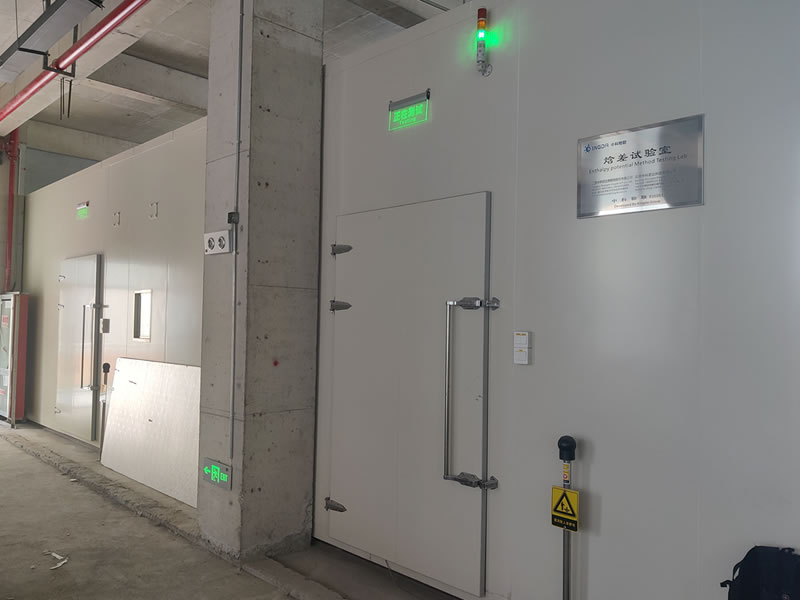
This laboratory was jointly constructed by Jimei University and Hangzhou Huadian Huayuan Environmental Engineering Co., Ltd. and has been completed on the campus of Jimei University. The project has received strong support and funding from the Fujian Provincial Government and the Xiamen Municipal Government. The laboratory covers an area of 600 m² and consists of five main parts: ice thermal storage and electric thermal storage machine room system, low-temperature air supply VAV air conditioning end performance testing platform, fan coil and variable air volume air conditioning unit thermal performance testing platform, low-temperature air supply system, and conventional air conditioning system. The main configurations and functions of each part are described below.
1.Thermal Storage and Heating Machine Room System
1.1 Composition:
One dual-condition refrigeration mainframe, 193 kW; one thermal storage electric boiler, 90 kW; four sets of heat-conducting plastic ice storage pipes, 211 kWh/set; one ice ball storage tank, 633 kWh; one thermal storage tank, 15 m³; three plate heat exchangers; and related other equipment, valves, and control instruments. The system uses PLC combined with a host computer to control and collect various parameters.
1.2 Functions:
Test the freezing and melting performance of various ice storage devices under various operating conditions to obtain performance curves; b) Test the performance of the refrigeration mainframe and various heat exchange devices in the machine room under different operating conditions; c) Test the performance indicators of the ice thermal storage system under different operating modes; d) Provide the required cold and hot media for each testing platform as needed; e) Provide cold sources for low-temperature air supply and conventional air conditioning for the entire building.
Low-Temperature Air Supply Air Conditioning End Performance Testing Platform
Composition: This platform is equipped with an air conditioning unit with an airflow of 800 m³/h, an air conditioning end testing room (7500 mm × 5000 mm × 2800 mm), three types of VAV terminals, and heat balance equipment in the testing room.
Functions: a) Compare the testing of low-temperature air supply and conventional air supply systems; b) Compare the performance of variable air volume terminal devices; c) Test the performance of different air outlets.
Fan Coil and Variable Air Volume Air Conditioning Unit Performance Testing Platform
Composition: This platform includes testing systems for fan coils and variable air volume air conditioning units, including testing chambers, air handling units, air and water parameter measuring instruments, and corresponding computer data collection systems.
Functions: a) Test the thermal performance (air volume, cooling and heating capacity, water resistance, input power, etc.) of various fan coils with an airflow of less than 2500 m³/h; b) Test the thermal performance of various variable air volume air conditioning units with an airflow of less than 5000 m³/h (same as above); c) Use two sets of testing systems to conduct overall performance testing on small air conditioning units (testing both indoor and outdoor units simultaneously).
Low-Temperature Air Supply Air Conditioning System
Composition: Composed of one low-temperature combined air conditioning unit (6000 m³/h), five different types of VAV terminal devices, low-temperature air outlets and ducts, related cold and hot water piping systems, and corresponding valve instruments.
Functions: a) Detect the performance indicators of the low-temperature combined air conditioning unit, various VAV terminal devices, and various low-temperature air outlets in actual engineering applications; b) Provide low-temperature air supply for the second-floor laboratory.
Conventional Air Conditioning End System
Composition: The engineering building of Jimei University has conventional air conditioning ends on the 1st, 3rd to 5th floors, with the west side of the 3rd floor using an air handling unit for air supply, while the others use fan coils. The cold source is provided by the ice thermal storage laboratory machine room system.
Functions: a) Provide on-site testing comparison data for the performance testing of the low-temperature air supply system; b) Provide summer air conditioning for various laboratories in the engineering building.
2. Function Development and Design Points of the Machine Room System
The machine room system is the heart of the laboratory. Its functions include providing cold and hot sources to various locations and testing platforms, as well as conducting performance tests on the machine room’s own equipment. Therefore, the design of the machine room system is the core of the entire laboratory’s development and research. This paper focuses on the machine room system of this laboratory. Figure 1 is the principle flow diagram of the machine room system. In this system, a dual-condition (ice-making condition and air conditioning condition) refrigeration mainframe is used to meet the switching of full ice storage and partial ice storage operating modes. Ethylene glycol brine is used as the low-temperature heat transfer fluid. Accordingly, there are primary and secondary ethylene glycol pumps. The 1# plate heat exchanger is used to provide 7°C cold water to various rooms in the building, the 2# plate heat exchanger provides cold sources to the fan coil and variable air volume air conditioning unit testing platform, and the 3# plate heat exchanger provides the necessary heat load for melting ice testing. All the heat sources in the system are provided by the thermal storage electric boiler. Pressure and temperature collection points for ethylene glycol brine are set at the inlet and outlet of the ice storage equipment, and a bidirectional flow meter is also set at the outlet for data collection during ice storage device freezing and melting tests. The following describes the design ideas and system flow based on the five functions of the machine room.
2.1 Experimental Methods for Obtaining Freezing and Melting Performance Curves of Ice Storage Equipment
2.1.1 Freezing Testing:
Water level measurement and heat measurement methods can be used separately. For ice storage equipment with external freezing, measuring the freezing speed based on the change in water level over time is a simple and feasible method due to the different densities of ice and water. For ice balls, however, the freezing speed must be obtained by calculating the heat transfer. According to the principle of heat exchange, the heat obtained by the ethylene glycol solution in the ice storage equipment within the time interval is calculated as follows: △Q = GcAtdr (1), where G is the flow rate of the ethylene glycol solution at a certain moment, kg/s; c is the specific heat capacity of the ethylene glycol solution, kJ/(kg·K), which can be considered a constant under testing conditions; At is the temperature rise of the ethylene glycol solution at the inlet and outlet of the ice storage equipment at a certain moment, °C. When the ice storage solution is in a mixture of ice and water, the corresponding amount of ice formed is: △m = (2), where m is the amount of ice formed, kg; R is the latent heat when the solution freezes, kJ/kg. G and △T can be collected through flow meters and temperature sensors at the inlet and outlet, and the collected data can be plotted as curves, regressed as functions of time t for G(t) and At(t). From equations (1) and (2), the cooling capacity and ice formation amount at each moment can be obtained. If equations (1) and (2) are integrated separately, the average cooling capacity and total ice formation amount over the time interval t can be calculated as follows: Q = ∫G(t)At(t)cdt (3) and m = ∫G(t)dt (4). During testing, flow G and one of the temperature parameters can also be set as constants, making calculations for equations (3) and (4) simpler and more accurate. The flow of the refrigerant during ice storage is as follows (see Figure 1): mainframe evaporator — valve V1 — flow meter K1 — ice storage pipe (ice storage tank) — valve V3 — 1# (2#) ethylene glycol primary pump — mainframe evaporator. Valves V2 (flow balance valve) and V6 (flow adjustment valve) are in operation during the ice storage period.
2.1.2 Melting Speed Testing:
Melting is the reverse operation of freezing, so the theoretical basis for freezing testing also applies to melting testing. The design of the system considers two methods for melting: utilizing end load melting and hot water load melting. End load melting tests the melting speed during the summer air conditioning period, and the results are more consistent with actual engineering; hot water load melting tests use hot water supplied by the thermal storage tank through the 1# hot water pump and the 3# plate heat exchanger. During melting, parameters of the ice storage equipment can be adjusted under three testing conditions: constant ethylene glycol flow and inlet temperature, constant ethylene glycol flow and outlet temperature, and constant inlet and outlet temperatures. For example, under the condition of constant ethylene glycol flow and inlet temperature, the flow of the ethylene glycol refrigerant during melting of the ice ball and ice storage pipe is as follows: a) Melting refrigerant flow for ice balls using end load: ice ball — flow meter K1 (K2) — valve V8 — ethylene glycol secondary pump — valve V10 — valve V12 — plate heat exchanger — valve V4 — valve V6 — ice ball. b) Melting refrigerant flow for ice storage pipes using end load: ice storage pipe outlet — flow meter K1 (K2) — valve V2 — 3# plate heat exchanger — single pipe melting ethylene glycol pump — mainframe evaporator — valve V5 — valve V6 — ice storage pipe inlet. Table 1 provides the system equipment and valve operation status for freezing and melting tests of the ice storage pipe.
2.2 Performance Testing of the Mainframe and Various Heat Exchange Equipment:
By changing the parameters set for the temperature sensors and pressure sensors on the refrigerant side of the mainframe, the refrigeration capacity, condensation load, power consumption, and COP under different operating conditions can be measured. Temperature and pressure sensors are also set on the ethylene glycol side of the evaporator inlet and outlet and the cooling water side of the condenser inlet and outlet. The refrigeration capacity and condensation load calculated from these can be compared with the refrigerant side.
This laboratory has the following features: a) Scale Feature: It is an ice thermal storage air conditioning technology research laboratory with actual engineering scale, capable of directly conducting experimental research on technical issues present in actual engineering. b) Multi-Function Feature: The laboratory consists of five main parts: ice thermal storage system thermal performance testing platform, low-temperature air supply VAV air conditioning end performance testing platform, fan coil and variable air volume air conditioning unit thermal performance testing platform, low-temperature air supply system, and conventional air conditioning system. These experimental platforms can support research content covering multiple aspects of ice thermal storage air conditioning technology. The laboratory can be used for scientific research, teaching, and performance testing of air conditioning equipment, making it a comprehensive multi-functional research center integrating scientific research, teaching, and product testing. c) Automatic Control Feature: The three main testing platforms in the laboratory all use a PLC fully automated control system, allowing parameter adjustment and data collection to be controlled via a computer. The establishment of the Jimei University and Hangzhou Huadian Huayuan Ice Thermal Storage Air Conditioning Technology Research Laboratory will promote the application and development of ice thermal storage air conditioning technology in China, positively impacting the healthy development of the economy and environmental protection.