

Abstract
This article develops and designs a fan testing fixture based on the complex operational processes involved in troubleshooting refrigerator fan failures in existing refrigerator laboratories. The device includes a control panel, mainboard, power supply, tachometer, and decibel meter. The mainboard consists of a PWM generation chip, which is electrically connected to the tachometer and decibel meter. Through the collaboration of the PWM generation device, decibel meter, and tachometer, the fixture can quickly determine whether the fan is faulty. Additionally, it can test the changes in fan speed and noise levels at different duty cycles, facilitating the verification of cooling performance and improving the efficiency of fan testing.
Keywords: Refrigerator; Fan Testing; Fixture
Currently, in the development and validation process of new refrigerators, prototypes often require repeated comprehensive performance tests such as power consumption, freezing capacity, and noise testing, which can be time-consuming and cumbersome. As a major refrigeration component, the performance of the fan directly affects cooling efficiency and refrigerator noise. Substandard fan performance can lead to inadequate cooling effects in refrigerators. At present, when testing fan performance, personnel often need to power the entire refrigerator, using a multimeter to test the continuity of various circuits and the integrity of the control board’s drive circuit. Alternatively, they may remove the fan and set up a 220V testing environment in the laboratory, along with special settings for the control program. The complex testing procedures may significantly impact product performance validation and development progress, while high-voltage testing environments increase safety risks for testers.
To address these issues and improve testing efficiency and safety, a fan testing fixture is designed, including a control panel, mainboard, power supply, tachometer, and decibel meter. The mainboard contains a PWM generation chip, which is electrically connected to the tachometer and decibel meter. Through the collaboration of the PWM generation device, decibel meter, and tachometer, the fixture can quickly determine whether the fan is faulty. It can also test the changes in fan speed and noise levels at different duty cycles, facilitating the verification of cooling performance and improving fan testing efficiency. This article will provide a detailed explanation of the structure, connection methods, and implementation of the testing methods of the fixture in refrigerators.
1 Design Scheme
The design of the fan testing fixture for refrigerators primarily includes three major components: structural design of the testing fixture, connection design, and testing method design. The testing fixture can quickly determine whether the fan is faulty in a safe low-voltage environment, while also testing the changes in fan speed and noise levels at different duty cycles.
1.1 Structural Design of the Testing Fixture
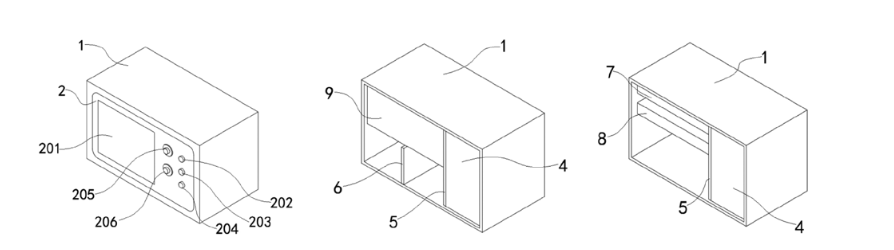
To achieve a compact and portable design for this testing fixture, the fixture design includes a casing (1) and a cover that forms a box and storage compartment. The storage compartment is divided into a power output compartment and a testing compartment by a partition (5). The output compartment is equipped with a power supply (4), which is a polymer lithium battery that includes a 5V port and a 12V port, providing power for the fan’s PWM port and voltage port, respectively. The testing compartment integrates a tachometer (7) for measuring fan speed and a decibel meter (8) for measuring fan noise.
Figure 1 shows the structural schematic. The control panel includes a display (201), power switch (202), tachometer switch (203), decibel meter switch (204), PWM frequency adjustment knob (205), and PWM duty cycle adjustment knob (206). The aforementioned components, including the power supply, PWM generator, tachometer, and decibel meter, are electrically connected via wiring harnesses, ensuring that once all parts are assembled, the testing fan can simply be connected to the power output terminal from the outside of the device. By adjusting the PWM frequency adjustment knob on the control panel to the fan’s rated frequency and then adjusting the PWM duty cycle adjustment knob to vary the duty cycle continuously between 0% and 100%, the decibel and speed values can be read on the display, allowing for fan testing with ease of operation and safety.
1.2 Connection Design
The overall connection diagram of the fan testing fixture is shown in Figure 2. The power supply is electrically connected to the power switch, and the power supply is also electrically connected to the mainboard. The mainboard is electrically connected to both the tachometer and the decibel meter. The tachometer switch is electrically connected to the tachometer, and the decibel meter switch is electrically connected to the decibel meter. Both the PWM frequency adjustment knob and the PWM duty cycle adjustment knob are electrically connected to the mainboard. The tachometer probe is electrically connected to the tachometer, and the decibel probe is electrically connected to the decibel meter. This connection method is simple and easy to operate, ensuring that actual use of this fixture can quickly proceed to the testing and verification phase.
1.3 Testing Method Design
When testing the fan, first connect the fan to the power output terminal of the testing fixture. Then, power on the fixture and adjust the output frequency and duty cycle of the PWM waveform using the PWM frequency adjustment knob and the PWM duty cycle adjustment knob. When the rated frequency of the fan is reached, use the tachometer and decibel meter to measure the rotational speed of the fan blades and the fan noise, displaying the values on the monitor. By comparing the actual data of the fan blade speed and noise levels with the theoretical data, one can determine whether the fan is functioning normally, thereby achieving the purpose of testing the fan.
2 Testing Effectiveness of the Testing Fixture
This article compares the testing fixture with traditional testing methods in terms of testing time, safety, portability, and ease of operation, with the results shown in Table 1. Compared to traditional testing methods, the testing fixture saves more than twice the time, significantly improving testing efficiency. Additionally, the testing fixture has the advantages of being compact and highly integrated, making it easy to carry and operate, which greatly enhances testing efficiency and shortens the testing and verification of performance during the product development process.
In actual tests, we found that the capacity degradation of multi-split units is less than the calculated values, with virtually no degradation under high-temperature conditions. Testing across multiple models revealed slight differences in degradation among the models, with the maximum degradation being approximately 15%.
3 Analysis and Conclusion
The differences between experimental testing and theoretical calculations actually involve pressure compensation and pressure limit frequency control in multi-split systems. Although long piping results in pressure loss, the pressure compensation control in multi-split systems can increase frequency. Systems without pressure compensation control may also experience an increase in frequency and output capacity due to reduced pressure, which pressure limit frequency. For example, in the models we studied under standard cooling conditions at 35°C, the frequency for short piping was 94 Hz, while for long piping it was 98 Hz, resulting in a reduction in overall degradation.
From the data, we can observe that whether through simulation calculations or experiments, as the outdoor temperature rises, the degradation of cooling capacity decreases. Therefore, when designing, we can focus on the standard cooling conditions. Generally, a 100-meter long piping results in a degradation of 10% to 15%, and specific degradation for different models needs to be analyzed and calculated individually.
Pressure loss is greatly related to pipe length and diameter. When designing and installing multi-split systems, it is essential to comply with the manufacturer’s specifications, selecting the appropriate pipe diameter and limiting pipe length. Proper insulation is also crucial to maximize the performance of the multi-split system. Based on the above analysis, we can more effectively guide the design and provide assurance for the effective operation of multi-split systems.