

Abstract
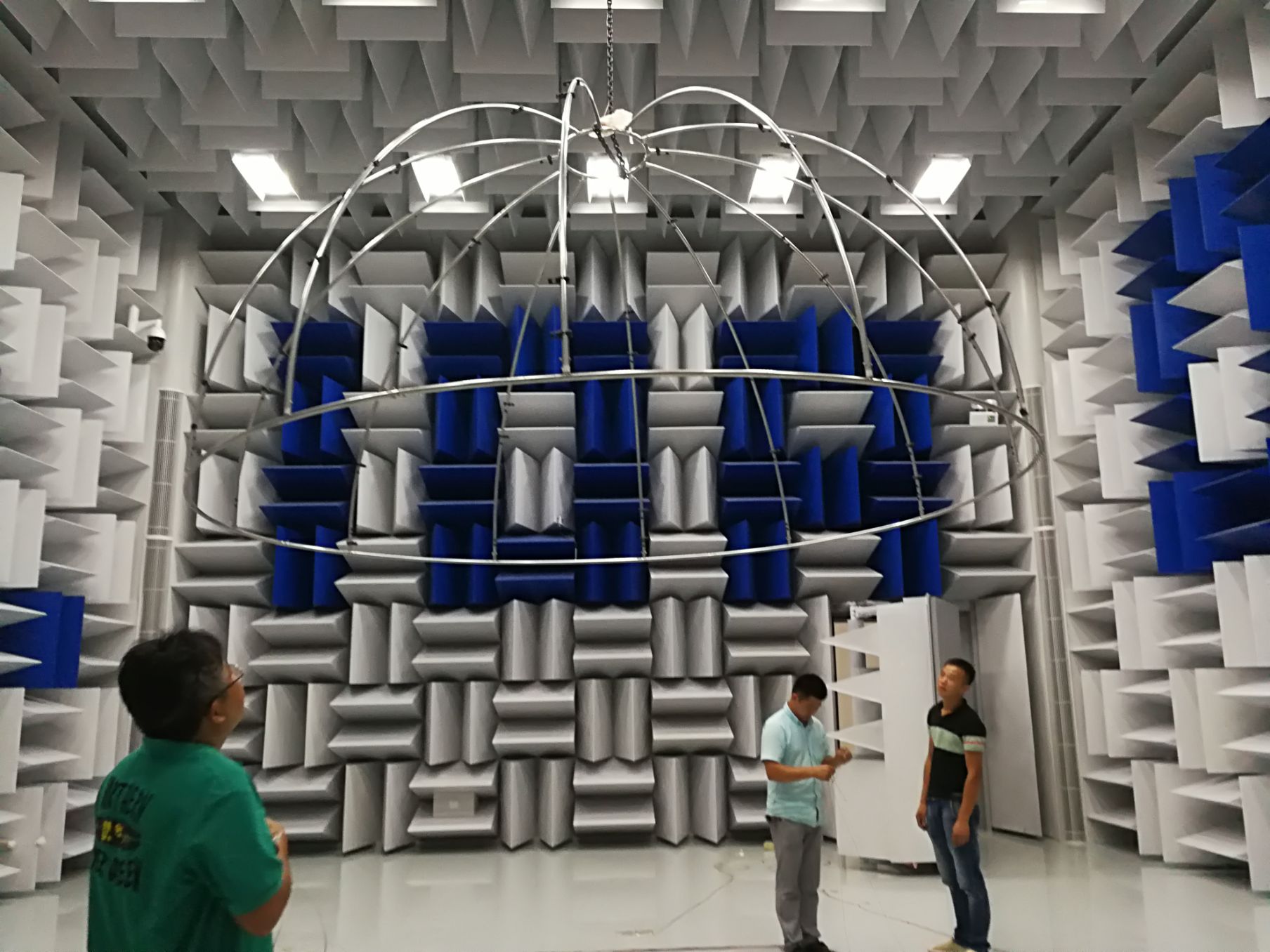
An anechoic room for air conditioners was developed based on GB/T 6882-86, which is used for testing the noise of air conditioners to determine if they meet national noise standards. Test results indicate that the anechoic room’s sound insulation and absorption performance meet design requirements. The free sound field and measurement error within the room exceed international and national standards, making it suitable for precise noise testing of various specifications of air conditioners across a wide capacity range.
Keywords: air conditioner; anechoic room; noise measurement
1. Introduction
All mechanical products generate noise pollution. To effectively control product noise, it is essential to accurately measure the noise of the entire unit or its components, allowing for the implementation of effective control measures. For air conditioners, which are closely related to people’s living and working environments, noise control has garnered special attention. Every type of air conditioner must undergo rigorous noise testing. To analyze and reduce air conditioner noise, developing a more efficient and precise anechoic room is crucial. Over the past half-century, anechoic rooms have become increasingly precise, intelligent, and dynamic. As the technical requirements for anechoic rooms have risen, the design and development of operational anechoic rooms have become essential. These rooms simulate the possible environmental conditions and operational states of the tested air conditioner, allowing for noise testing that closely resembles actual usage conditions.
2. Technical Specifications
The anechoic room described in this paper is designed for testing single-phase and three-phase air conditioners, with a maximum testing capacity of 5-10 units, including window, split, and cabinet models. The anechoic room consists of two sections: an inner fully anechoic chamber and an outer semi-anechoic chamber.
- Background Noise: (when the air handling unit’s fan operates slowly, with no abnormal interference such as impact or vibration)
- Inner chamber ≤ 16 dB(A)
- Outer chamber ≤ 18 dB(A)
- Environmental Noise: Ambient noise ≤ 70 dB(A)
- Other Parameters: The lower frequency limit for testing in the anechoic room is 100 Hz. The free sound field and measurement error comply with the provisions of GB/T 6882-86, with some parameters shown in Table 1.
Table 1: Maximum Allowable Differences Between Measured and Theoretical Sound Levels
| Testing Room Type | 1/3 Octave Band Center Frequency (Hz) | Allowable Difference (dB) |
|---|---|---|
| ≤ 630 | ± 1.5 | |
| Anechoic Room | 800-5000 | ± 1.0 |
| ≥ 6300 | ± 1.5 | |
| ≤ 630 | ± 2.5 | |
| Semi-Anechoic Room | 800-5000 | ± 2.0 |
| ≥ 6300 | ± 3.0 |
3. Design of the Anechoic Room
The design of the anechoic room is based on GB/T 6882-1986 “Measurement of Noise Source Sound Power Level – Precision Method for Anechoic and Semi-Anechoic Rooms,” GB/T 4214.1-2000 “Noise Testing Methods for Household Appliances and Similar Equipment,” and ISO 3745 “Measurement of Noise Source Sound Power Level – Precision Method for Anechoic and Semi-Anechoic Rooms.” According to the standards and testing product requirements, the inner chamber has a marble floor, while the other five surfaces are designed with sound-absorbing wedges. The design aims for a cutoff frequency of 100 Hz, with a free sound field radius greater than 2 m and a measurement error of less than 1 dB.
3.1 Sound Absorption Design
Starting in the 1940s, the application of transitional principles has led to the development of porous or fibrous materials shaped into conical or wedge-shaped sound absorbers, collectively known as sound-absorbing wedges. When sound waves hit the tip, the gradually transitional properties of the absorber material allow for effective absorption. The sound absorption characteristics of the wedges are related to their length, filling material, and cavity depth. Longer wedges generally provide better low-frequency absorption. The cutoff frequency is designed at 100 Hz, leading to a calculated wedge length (including cavity) of approximately 0.85 m.
3.2 Sound Insulation Design
The external noise level measured outside the semi-anechoic room is 70 dB(A). The outer chamber consists of a reinforced concrete frame and a 370 mm thick solid brick wall, providing an estimated sound insulation level of about 50 dB(A). The inner lining consists of 200 mm thick composite sound insulation panels.
3.3 Sound Absorption Design
The design includes outdoor sound-absorbing exhaust and intake vents on the southern side and both the eastern and western walls of the anechoic room. Fans are placed in a dedicated room, connected through a resistive silencer to the exhaust vent.
3.4 Vibration Isolation of the Anechoic Room
In cases of high external noise or when vibration measurements are required, a floating structure is typically employed to isolate external influences. The design utilizes spring isolation, with each spring capable of supporting a load of 7.5 tons.
4. Performance Testing Results and Analysis
4.1 Background Noise Testing
The measured background noise in the semi-anechoic room, with the fan operating, is 17.1 dB(A), exceeding the design requirement of ≤ 18 dB(A).
4.2 Free Field Radius and Measurement Error
The sound field reflection deviation was measured using a standard sound source placed in the center of the anechoic room, with measurement points taken at radii of 1.0 m and 1.5 m.